

The Sri Lankan Table: A Deep Dive into the Island's Most Extraordinary Cuisine
Rice, Curry, Coconut and the Flavours That Make This the Most Underrated Food Destination in Asia
Dilshan Mendis
Food & Culture Correspondent
The first meal matters. In Sri Lanka, if you are lucky, it arrives before 08:00: a thin, lacy, bowl-shaped hopper — a fermented rice and coconut-milk crêpe with a crisp, gossamer edge and a soft, yielding centre cradling a single egg — served with a dark, slow-cooked onion sambol and a smear of coconut pol sambol so vivid it looks painted. You eat it with your right hand. You order another. This is how Sri Lankan food begins, and from here, it only intensifies.
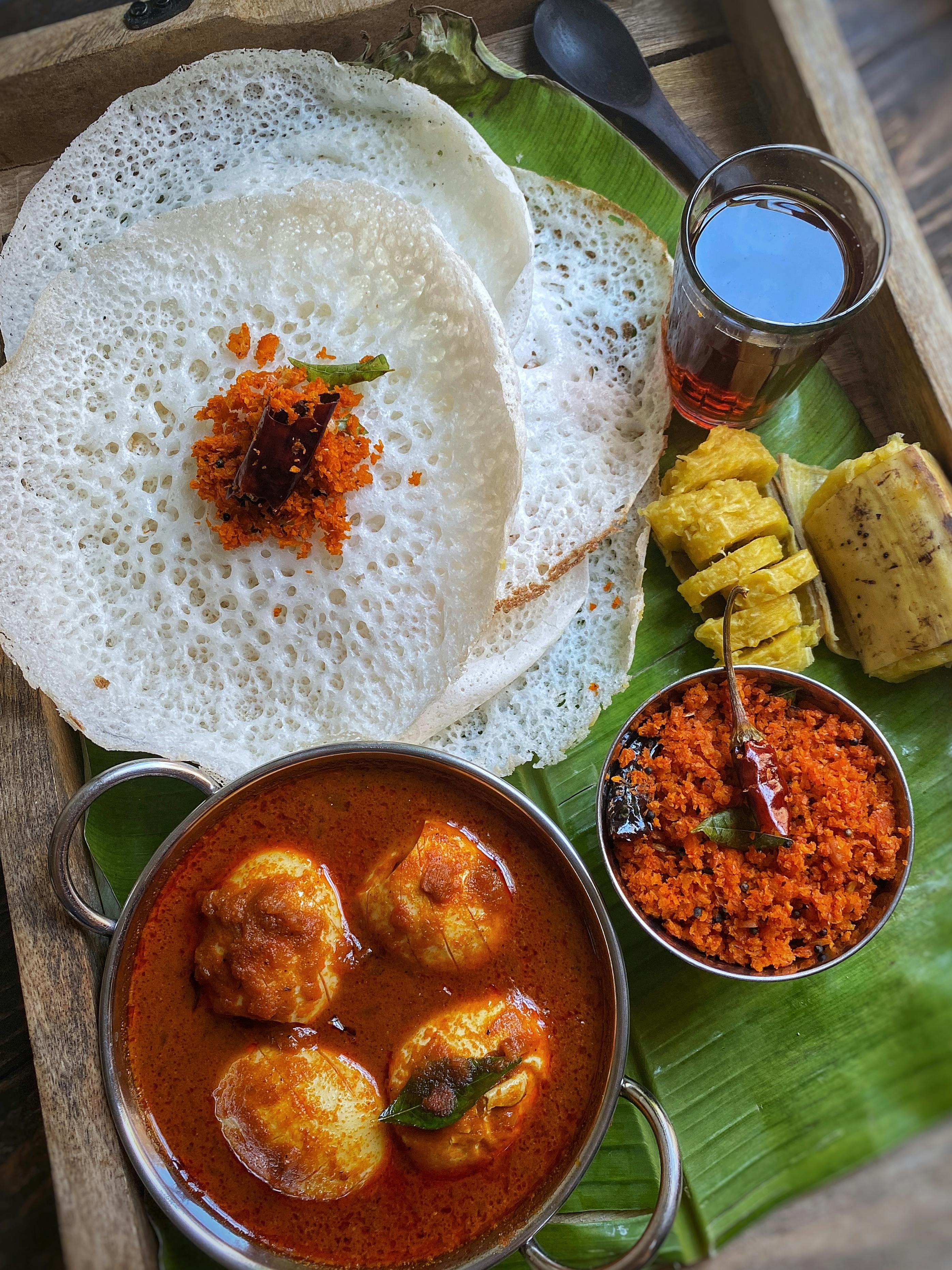
There is no single dish more central to Sri Lankan identity than the rice and curry — yet the term is as reductive as calling French cuisine 'bread and sauce.' At its full expression, a proper Sri Lankan lunch consists of red or white rice alongside a minimum of five preparations: a fish or meat curry cooked with goraka (a dried tamarind-like souring agent), a dhal (parippu) cooked with tempered mustard seeds and fresh curry leaves, one or two malluma — finely chopped green vegetables mixed with fresh coconut and lime — and two types of sambol: coconut pol sambol (grated coconut, red chilli, lime, and Maldive fish) and lunu miris (a pulverised red-onion and dried-chilli paste of controlled savagery). The rice is not a base for these dishes. It is a participant — the starchy counterpoint that transforms five different flavours into a single coherent meal.
Kottu roti is Sri Lanka's great street-food theatre: flat, layered roti chopped with vegetables, egg, and your choice of protein on a searingly hot iron griddle by a chef wielding two steel blades. The sound — a rhythmic, metallic chop-chop-chop that carries half a kilometre in the evening air — is one of the definitive sounds of the Sri Lankan night. String hoppers (idiappam) are another morning staple: steamed rice-noodle nests eaten with coconut milk and a thin dhal curry, their delicacy a complete contrast to the robustness of kottu. Lamprais — Dutch-influenced rice cooked in stock with a combination of curries and a plantain-leaf-wrapped packet — is an almost archaeological dish, a remnant of Dutch colonial trade that has survived as a Sunday institution. For something from the sea, the curry made from fresh tuna cooked in clay pots along the southern coast — ambul thiyal — with goraka and black pepper is the most intensely flavoured fish dish in any coastal cuisine in the world.

Sri Lanka's Tamil north has a culinary identity so distinct from the Sinhala south that it constitutes a separate cuisine. Jaffna's cooking is built on fresh palmyra palm products, thick lentil preparations, and an extremely high tolerance for fresh red chilli. The signature dish is Jaffna crab curry — enormous mud crabs from the Jaffna Lagoon cooked in a thin, fiery, near-black curry that turns deep red in the bowl. Point Pedro mutton curry (a spiced, slow-braised preparation served with string hoppers), the palmyra fruit jelly called nungu, and the various preparations of fresh jackfruit unique to northern Tamil cooking make Jaffna an essential detour for any serious food traveller. The food is entirely unlike anything else in South Asia.
Where to Eat: From Street to Fine Dining
- 01
For hoppers: Ministry of Crab's sister restaurant Nuga Gama at Cinnamon Grand (Colombo) for fine-dining Sri Lankan; any roadside kadeé or local home-restaurant for authentic morning hoppers at LKR 30–60 each.
- 02
For kottu: The street stalls on Galle Road in Colombo's Bambalapitiya after 21:00 serve some of the city's finest — order chicken or cheese kottu, watch it made in front of you.
- 03
For rice and curry: Seek out family-run restaurants (look for handwritten menus, plastic chairs, and full tables of locals) rather than tourist-facing establishments — quality is invariably higher and prices are half.
- 04
For fine dining: Ministry of Crab (Colombo) serves Sri Lankan lagoon crab at world-class level. Awarded in Asia's 50 Best Restaurants, it requires advance booking.
- 05
For Jaffna food in Colombo: Palmyrah Restaurant at Hotel Renuka serves the most authentic northern cuisine in the capital — order the crab curry and the string hopper breakfast set.
“Sri Lankan cuisine is not fusion. It is convergence — two thousand years of trade, colonisation, and cultural exchange compressed into a single banana-leaf meal.”
Sri Lanka exports cinnamon, cardamom, cloves, nutmeg, and black pepper — and uses all of them with a confidence that comes from growing them in the garden. The cinnamon here is true cinnamon (Cinnamomum verum), not the cassia bark sold in most Western supermarkets: it is lighter, sweeter, and more complex, and it is used in both sweet and savoury preparations. The curry leaf (karapincha) is not an optional garnish but a structural flavour — added at the beginning of cooking in hot coconut oil, it transforms the base of every dish. Rampe (pandan leaf) gives the rice its faint floral note. Goraka — the dried, smoked fruit of the Garcinia cambogia — provides the souring depth in fish curries. Understanding these ingredients turns every meal from a mystery into a conversation.
Colombo's Manning Market, operating from 03:00 in the wholesale fruit and vegetable sections, is one of the great sensory experiences of South Asia. By 06:00, the retail sections are fully operational: stalls selling fresh Sri Lankan bread (paan), pyramids of Maldive fish, wall-to-wall dried spices, and fresh gotukola (pennywort), the bitter green used in the eponymous salad. In Kandy, the Central Market near the bus stand offers excellent local produce and a second-floor section of street-food stalls serving genuine local breakfasts — string hoppers, hoppers, pittu, and por (a roti variation) — to the market workers from 05:30. It is, without question, the best meal in the hill country for under LKR 300.
Sri Lankan Food: A Practical Glossary
- 01
Pol sambol — Grated fresh coconut, red chilli, onion, lime, and Maldive fish. Served with almost everything. The single most ubiquitous condiment in Sri Lankan cooking.
- 02
Parippu — Red lentil dhal cooked with cumin, mustard seeds, curry leaves, and tempered onion. The everyday backbone of the rice-and-curry plate.
- 03
Wambatu moju — Pickled aubergine, fried then preserved in a sweet-spiced vinegar. An essential side that improves over 48 hours in the jar.
- 04
Curd and treacle — Buffalo curd (thick, slightly sour) topped with kithul treacle (dark palm sugar syrup). The perfect dessert and the most purely Sri Lankan thing you will eat.
- 05
Thambili — King coconut water, sold roadside in the orange shell. The finest natural sports drink in the world, and free of the sugar and additives of anything from a bottle.
Photo Journal
4 Images from the Field

The rice-and-curry spread — a meal where restraint is considered poor hospitality

Egg hoppers with pol sambol — the morning ritual that defines the Sri Lankan day

Kottu roti preparation on the hot iron — street food as performance art

Colombo's spice markets — cinnamon, cardamom, and cloves that define a national cuisine
Dilshan Mendis
Food & Culture Correspondent
Dilshan writes at the intersection of food, history, and identity. A former chef who retrained as a journalist, he has eaten in every province of Sri Lanka — from Jaffna's Tamil kitchens to the fish markets of Negombo.
Want This Experience
For Yourself?
Our guides have the access, knowledge and contacts to make experiences like this happen for you.